


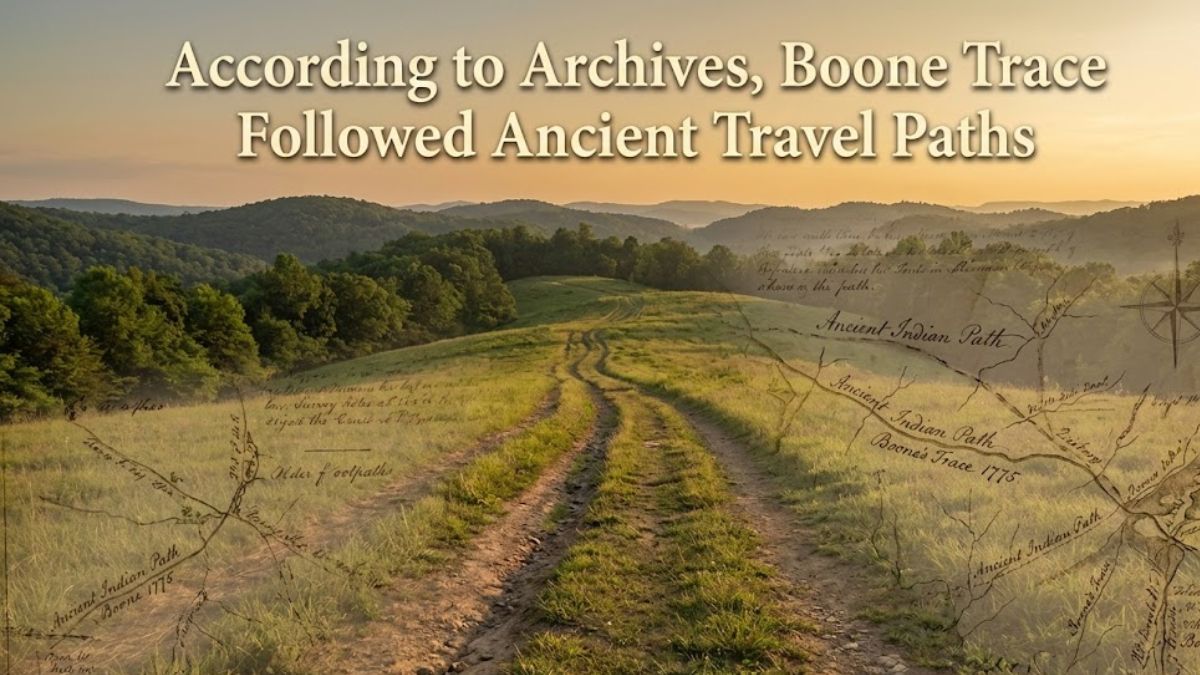
When we think about early American travel routes, many people imagine packed wagon trains or rugged frontier trails carved by settlers. Yet long before European settlers arrived, Indigenous communities had already mapped out the land through years of movement, trade, and seasonal migrations. According to historical archives and research, Boone Trace followed these ancient travel paths, adapting and expanding routes that Indigenous people had used for generations.
This deep connection between Indigenous networks and what became known as Boone Trace reveals a richer story about how early Americans moved across the land. It also highlights the importance of acknowledging the origins and layers of history embedded in the American landscape.
Indigenous Routes Preceded European Trails


Long before the 18th century, Native American tribes developed networks of footpaths, connecting villages, hunting grounds, water sources, and trade centers. These routes were practical, efficient, and suited to the natural terrain. They followed ridges, river valleys, and natural passes through mountains, avoiding the hardest obstacles while linking communities across vast regions.
When settlers began exploring beyond the eastern colonies, many of the earliest routes they adopted were not entirely new. Instead, they followed the lines carved and perfected by Indigenous peoples over centuries.
Archives Confirm Historical Continuity
Historians studying Boone Trace have repeatedly found archival evidence that points to its pre-colonial origins. Early maps, explorers’ journals, and Native American records show pathways that align closely with sections of Boone Trace. These historical documents demonstrate that Daniel Boone and other frontiersmen did not invent a route out of thin air. Rather, they expanded and improved existing trails, widening narrow paths to accommodate horses and simple wagons.
For settlers unfamiliar with the terrain, this Indigenous knowledge was indispensable. They relied on guides, interpreters, and local knowledge passed down through many generations. These early trail networks were not random; they were optimized through long experience and deep ecological understanding.
Daniel Boone: Guide and Adapter of Existing Paths
Daniel Boone is often credited with blazing new trails into the frontier. While his role is significant, archival evidence suggests Boone was much more a guide and adapter than an inventor of routes. In many cases, Boone followed paths known to Native Americans long before his arrival.
In constructing what became known as Boone Trace, Boone drew on:
- Indigenous path networks
- Guides familiar with the land
- Natural terrain features such as river crossings and mountain gaps
This collaboration between Indigenous trail systems and settler needs shaped the trail that many would follow into the Kentucky frontier.
The Significance of Ancient Travel Paths
Ancient travel paths were not merely ways to get from point A to point B. They held cultural, economic, and social significance. Tribes used these routes to:
- Exchange goods and information
- Visit seasonal lands for hunting or gathering
- Connect distant kinship networks
- Conduct diplomacy and alliance building
As settlers adapted these paths, they were unknowingly stepping onto landscapes embedded with cultural memory, meaning, and human movement that long preceded them.
The Transformation of Paths into Trails
The shift from Indigenous footpaths to colonial-era trails happened gradually. Early settlers walked beside Native Americans, learning the terrain and ways to navigate it. Over time, as more settlers traveled these routes, paths became wide enough for horses and wagons. Landmarks used by Indigenous travelers—such as certain river fords, ridge lines, and bends in the terrain—remained key features of the trail.
By the time Boone Trace became widely known among settlers, the route already bore the imprint of centuries of travel and adaptation.
Impact on Westward Expansion
Boone Trace played a crucial role in the movement westward, but its foundation on ancient paths meant settlers were benefiting from deep Indigenous knowledge of geography. Without these earlier routes, settlers would have faced far greater challenges crossing dense forests, steep mountains, and unpredictable terrain.
The reuse and expansion of ancient travel paths helped speed the settlement process. Towns, forts, and homesteads became established along the route, further embedding the trail into American movement patterns.
Modern Implications and Recognition
Today, recognizing that Boone Trace followed ancient travel paths changes how we understand early American history. It challenges the myth that settlers forged entirely new routes through untouched wilderness. Instead, it highlights a history of adaptation, exchange, and survival knowledge that Indigenous peoples developed over generations.
This recognition also raises important questions about preservation and memory. Much of the trail has disappeared under roads, farms, and modern development. As historians and local communities work to preserve what remains of Boone Trace, acknowledging its Indigenous origins becomes essential to telling a fuller, more truthful story.
Why This History Matters Now
Understanding that Boone Trace followed ancient travel paths is critical for several reasons. First, it honors the long history of Indigenous innovation and movement on this land. Second, it provides a more accurate and inclusive account of how early travel networks developed. Third, it reminds us that modern landscapes are layered with human histories that deserve recognition, respect, and preservation.
As people explore and preserve fragments of Boone Trace today, these ancient origins offer a richer cultural context—one that connects generations of travelers across time.
Conclusion
According to archives and historical research, Boone Trace was not an entirely new path carved by settlers. Instead, it followed and expanded ancient Indigenous travel paths that had guided people across the region for centuries. This continuity reveals a deeper, richer story of human movement, knowledge sharing, and landscape understanding.
Recognizing these ancient roots helps reshape how we think about frontier history, settlement patterns, and the many lives intertwined with these land routes. In preserving what remains of Boone Trace, we honor not just a single trail but generations of travelers who walked these paths long before it was ever called Boone Trace.