

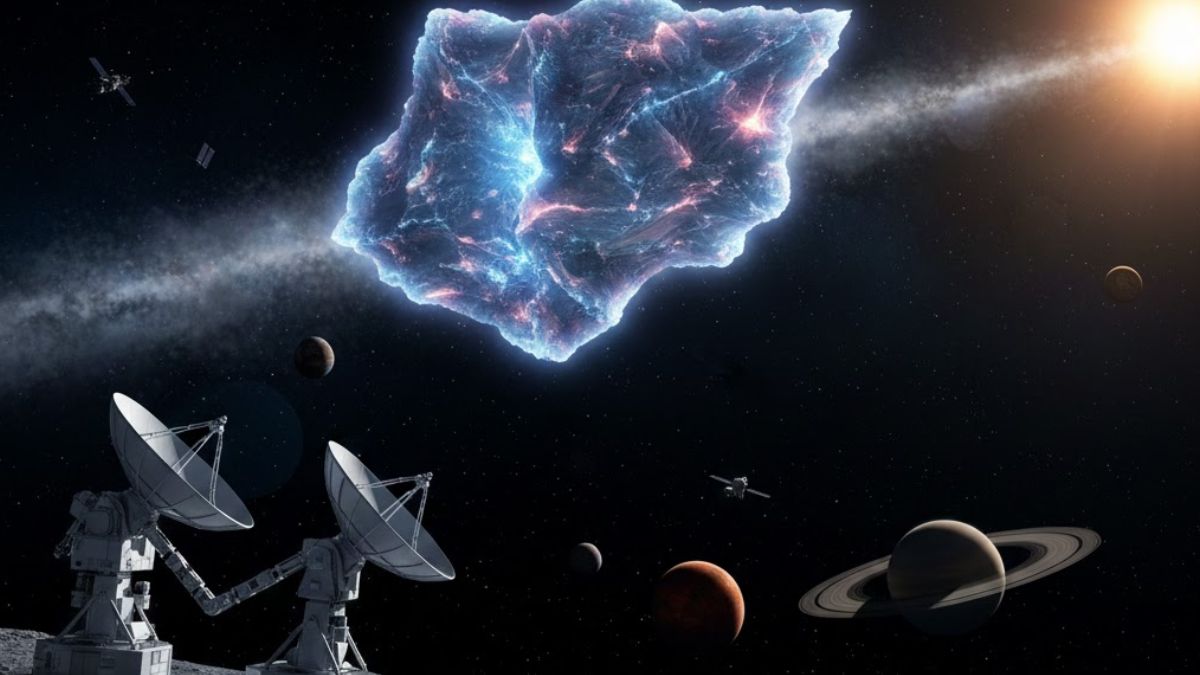
The vastness of space is filled with mysteries, and every so often, one of those mysteries comes rushing toward our cosmic neighborhood. Recently, astronomers confirmed the detection of a high-velocity object entering the solar system, traveling at an astonishing 245,000 kilometers per hour. Classified as a potential interstellar visitor, the object has captured the attention of scientists worldwide, prompting careful monitoring and renewed public fascination with what lies beyond our Sun’s gravitational domain.
While there is no indication of danger to Earth, the discovery represents a rare and scientifically valuable event—one that offers insight into the formation of other star systems and the dynamic nature of the galaxy itself.
What Does “Entering the Solar System” Really Mean?


The solar system is dominated by the Sun’s gravity, which governs the motion of planets, moons, asteroids, and comets. Most objects detected within this region originated here billions of years ago. However, occasionally, astronomers observe an object whose speed and trajectory suggest it did not form around our Sun.
An object entering the solar system at 245,000 km/h is moving far faster than most native asteroids and comets. Such extreme velocity is one of the strongest indicators that the object may have originated outside our solar system, possibly from another star system entirely.
These objects are often referred to as interstellar objects—cosmic travelers ejected from their home systems by gravitational interactions or stellar events.
How the Object Was Detected

Modern astronomy relies on a global network of observatories, space telescopes, and automated sky-survey systems. These instruments constantly scan the sky, comparing images over time to identify moving objects.
In this case, the object was detected due to:
- Its unusual speed, far exceeding that of typical solar system bodies
- A hyperbolic trajectory, indicating it is not gravitationally bound to the Sun
- Brightness variations, suggesting a solid object rather than space debris
Once detected, data was quickly shared among international space agencies and observatories. Astronomers began refining calculations to determine its path, origin, and physical characteristics.
Why Astronomers Are Watching Closely
A Rare Scientific Opportunity

Interstellar visitors are exceptionally rare. Only a handful have ever been observed with sufficient detail. Each one offers a direct sample—albeit from afar—of material formed around another star.
Studying such objects can help scientists understand:
- How planetary systems form elsewhere in the galaxy
- The chemical composition of distant regions of space
- The processes that eject objects from their parent systems
Natural, Not Artificial
Whenever an unknown object enters the solar system, speculation can arise. Scientists emphasize that there is no evidence suggesting artificial origin. Observations so far are consistent with a naturally occurring astronomical body, such as an asteroid or comet-like object.
Speed That Sets It Apart
At 245,000 km/h, this object is moving fast enough to travel from Earth to the Moon in just over an hour. Such speed strongly suggests it is not bound by the Sun’s gravity and will pass through the solar system only once before continuing its journey into interstellar space.
For comparison:
- Typical asteroids orbit at tens of thousands of km/h
- Comets accelerate as they approach the Sun but usually remain gravitationally bound
- Interstellar objects maintain extreme speeds even after solar flybys
This velocity allows astronomers to calculate its origin and predict its exit trajectory with remarkable precision.
Is There Any Risk to Earth?
One of the first questions people ask is whether such an object poses a threat. Based on current tracking data:
- There is no collision risk with Earth
- The object’s trajectory keeps it at a safe distance
- Continuous monitoring ensures early warning if conditions change
Space agencies maintain planetary defense programs precisely for this reason. Even when an object is not hazardous, close observation improves detection and response capabilities for future discoveries.
What Is the Object Made Of?
Although direct sampling is not possible, astronomers can infer composition using spectroscopy—analyzing how light reflects off the object.
Early observations suggest possibilities such as:
- Rocky, asteroid-like material
- A dormant comet with little surface ice
- A dense, metallic structure formed in another system
As the object approaches the Sun, changes in brightness or outgassing could reveal more about its nature.
A Brief History of Interstellar Visitors
This is not the first time humanity has observed such a phenomenon. Past detections have already reshaped scientific understanding, proving that objects routinely travel between star systems.
These discoveries confirmed that:
- Planetary systems are dynamic and occasionally eject material
- The galaxy is filled with wandering debris from star formation
- Interstellar exchange of material may be more common than once believed
Each new detection builds on that knowledge, refining models of galactic evolution.
How Long Will It Be Visible?
Because of its high speed, the object will remain observable for a limited time. Astronomers are racing to collect as much data as possible before it exits the inner solar system.
During this window, scientists aim to:
- Measure rotation and shape
- Analyze surface composition
- Monitor interaction with solar radiation
Once it departs, it may never be seen again.
Public Fascination and Scientific Responsibility
Events like this naturally capture public imagination. Headlines referencing “galactic visitors” spark curiosity and wonder—but scientists stress the importance of accurate interpretation.
This object is:
- A natural astronomical phenomenon
- Not a threat
- Not evidence of extraterrestrial technology
Its true value lies in what it can teach us about the universe beyond our own stellar neighborhood.
What This Means for the Future of Space Science
The detection highlights the growing power of modern astronomy. With improved telescopes and AI-assisted surveys, scientists expect to detect many more interstellar objects in coming years.
Future possibilities include:
- Dedicated missions to intercept interstellar objects
- Advanced early-warning systems
- Greater understanding of galactic material exchange
Each discovery brings us closer to understanding our place in a dynamic, interconnected galaxy.
Conclusion
The confirmation of a high-speed object entering the solar system at 245,000 km/h is a reminder that space is far from empty or static. These rare visitors offer a fleeting but profound glimpse into worlds beyond our own, carrying information formed around distant stars billions of years ago.
As astronomers continue to watch and learn, this galactic visitor becomes more than just a curiosity—it becomes a messenger from the wider universe. While it poses no danger, it fuels scientific discovery, inspires public wonder, and reinforces a powerful truth: our solar system is part of a vast, ever-moving cosmic network, and sometimes, the universe comes to visit.